
| Affiliate disclosure: This article may contain affiliate links. If you buy through them, AIGearTools may earn a commission at no extra cost to you. Commercial relationships never determine inclusion or ranking. Editorial note: Features and access were checked against official product information on 31 July 2026. Plans, limits, model names and availability can change. Confirm critical details on the vendor’s website. |
Quick answer
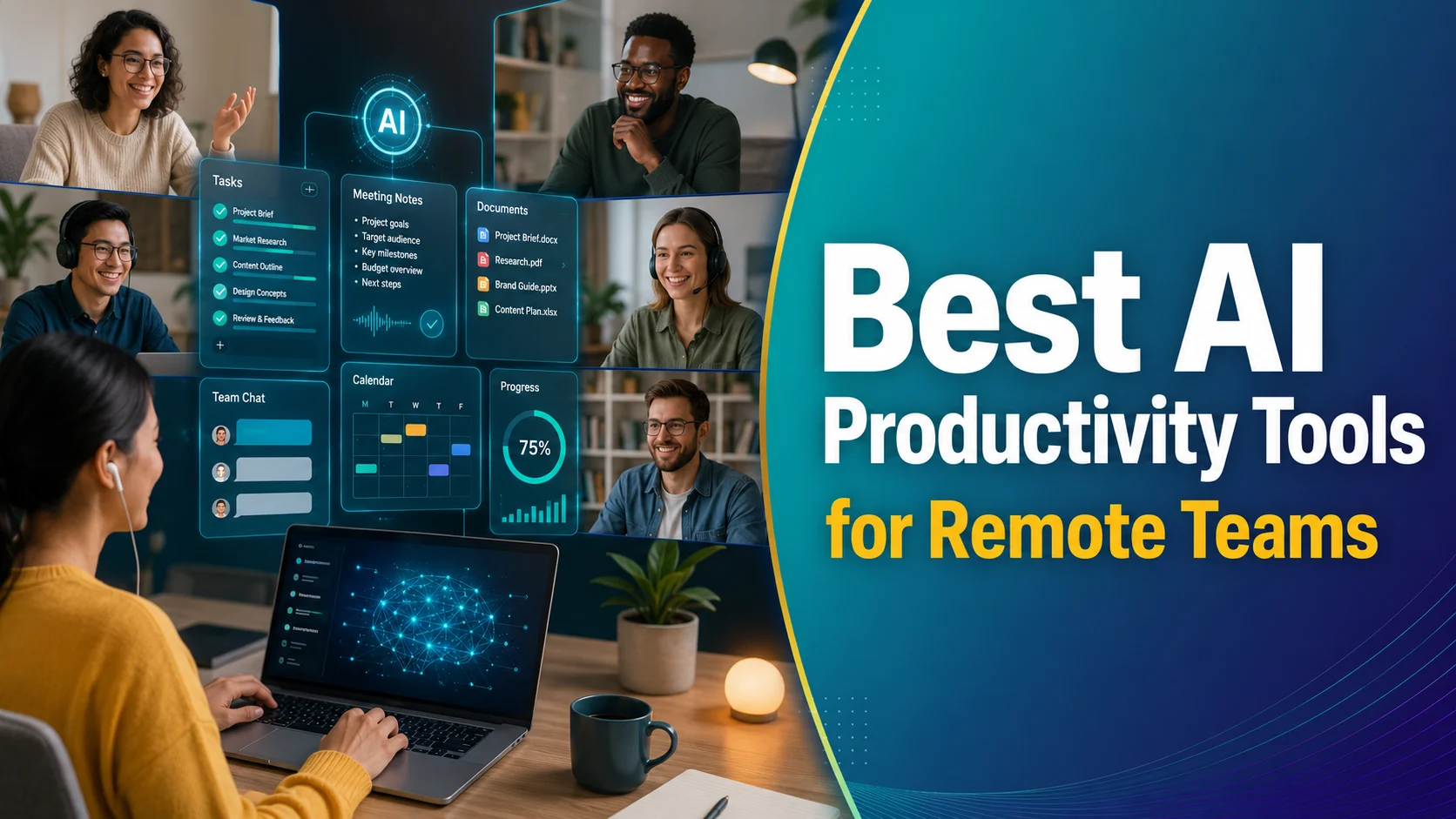
Notion AI is the best overall collaboration tool for remote teams that need a shared knowledge and project hub. Slack AI is best for conversational catch-up, Microsoft 365 Copilot and Google Workspace with Gemini lead their respective suites, Zoom AI Companion focuses meeting follow-up, Asana AI Studio supports structured project workflows, Rovo serves Jira and Confluence teams, and Miro AI leads visual workshops.
Remote teams do not need more generated text; they need less time lost between a conversation, a decision and an owned next step. The best collaboration AI finds permissioned context, shows where it came from and moves work forward without creating another disconnected feed.
This page is intentionally narrower than AIGearTools’ existing productivity roundup. It compares systems for shared knowledge, communication, meetings, projects and workshops, then recommends choosing inside the team’s current suite before adding overlapping tools.
Start with the complete hub: 38 Best Emerging AI Tools to Try in 2026.
Quick picks
| Rank | Tool | Best for | Access model |
| 1 | Notion AI | connected knowledge, projects and writing | Paid / varies |
| 2 | Slack AI | conversation search and channel summaries | Paid / varies |
| 3 | Microsoft 365 Copilot | Teams meetings and Microsoft work context | Paid / varies |
| 4 | Google Workspace with Gemini | Docs, Meet and Gmail collaboration | Paid / varies |
| 5 | Zoom AI Companion | meeting summaries and follow-up | Paid / varies |
| 6 | Asana AI Studio | workflow automation around project work | Paid / varies |
| 7 | Atlassian Rovo | Jira and Confluence search and agents | Paid / varies |
| 8 | Miro AI | visual collaboration and workshop synthesis | Enterprise quote |
How we evaluated these tools
This is a documentation-led editorial comparison, not a claim that every product was tested in every possible environment. We reviewed official product pages, help centres and current feature documentation, then ranked the shortlist by task fit, output control, workflow depth, export options, collaboration, governance and the amount of human review still required. A tool earns a higher position when it solves a clear job reliably and makes its limitations understandable – not because it has the longest feature list.
Before publication, add first-hand screenshots, sample outputs and dated test notes wherever the editorial team has actually used the product. Do not present vendor claims as independent benchmark results. For a fair trial, give every tool the same source material, success criteria and time budget, then record failure modes as well as impressive outputs.
The best tools, reviewed
1. Notion AI – Best for connected knowledge, projects and writing
Official product: Notion AI
Notion AI is our pick for connected knowledge, projects and writing. Notion AI works across pages, databases, projects and connected knowledge to answer questions, summarise, draft and help teams turn information into action. It is the best overall choice for remote teams willing to make Notion a shared operating layer.
Where it fits: choose Notion AI when connected knowledge, projects and writing is the bottleneck you are trying to remove. Search quality depends on permissions, ownership and content hygiene. AI cannot resolve duplicate pages, missing decisions or a workspace without governance. Run a representative pilot before moving an entire team or production workflow.
Strengths
- Knowledge, writing, projects and AI live in one flexible workspace.
- Connected search can reduce time spent finding distributed context.
Limitations
- Requires information architecture and page ownership.
- A flexible workspace can become inconsistent at scale.
Pricing and access: Available through eligible Notion plans and AI packaging; features and usage vary by workspace tier.
AIGearTools verdict: Best overall for remote teams building a searchable knowledge and project hub.
2. Slack AI – Best for conversation search and channel summaries
Official product: Slack AI
Slack AI is our pick for conversation search and channel summaries. Slack’s AI features help people search conversations, summarise channels and threads, and catch up on missed work. The product is strongest when the collaboration record already lives in well-structured Slack channels.
Where it fits: choose Slack AI when conversation search and channel summaries is the bottleneck you are trying to remove. A summary can miss the final decision or a restricted source, and chat should not become the only system of record for durable work. Run a representative pilot before moving an entire team or production workflow.
Strengths
- Reduces catch-up time inside the communication stream.
- Respects workspace access while surfacing conversational context.
Limitations
- Value falls when channels are noisy or poorly organised.
- Important decisions still need a durable home.
Pricing and access: Available on eligible paid Slack plans or AI packaging; availability and administration vary.
AIGearTools verdict: Best for remote teams whose largest collaboration cost is catching up in Slack.
3. Microsoft 365 Copilot – Best for Teams meetings and Microsoft work context
Official product: Microsoft 365 Copilot
Microsoft 365 Copilot is our pick for Teams meetings and Microsoft work context. Microsoft 365 Copilot can assist across Teams, Outlook, Word, Excel and other permitted work context. For remote organisations standardised on Microsoft, the cross-application graph is its main advantage.
Where it fits: choose Microsoft 365 Copilot when teams meetings and microsoft work context is the bottleneck you are trying to remove. Permissions, oversharing, content quality and licensing must be addressed before rollout. A broad assistant can expose existing information-governance problems. Run a representative pilot before moving an entire team or production workflow.
Strengths
- Broad context across meetings, documents, email and work apps.
- Strong administrative fit for Microsoft-centric enterprises.
Limitations
- Licensing and rollout are substantial organisational decisions.
- Existing permission sprawl becomes more visible and consequential.
Pricing and access: Requires eligible Microsoft 365 accounts and applicable Copilot licences; products and agent usage can have separate terms.
AIGearTools verdict: Best for Microsoft-centric remote organisations that are ready for a governed suite deployment.
4. Google Workspace with Gemini – Best for Docs, Meet and Gmail collaboration
Official product: Google Workspace with Gemini
Google Workspace with Gemini is our pick for Docs, Meet and Gmail collaboration. Gemini assists across Gmail, Docs, Sheets, Slides, Drive and Meet, giving Google Workspace teams a native way to draft, summarise and retrieve collaborative context. It is the best suite-level alternative to Microsoft 365 Copilot.
Where it fits: choose Google Workspace with Gemini when docs, meet and gmail collaboration is the bottleneck you are trying to remove. Features differ across accounts, regions and rollouts, while file permissions and Drive organisation determine what useful context can be found. Run a representative pilot before moving an entire team or production workflow.
Strengths
- Native assistance across familiar Google collaboration apps.
- Good fit for distributed teams already centred on Drive and Meet.
Limitations
- Availability and limits vary by edition.
- Drive sprawl and weak sharing hygiene reduce usefulness.
Pricing and access: AI features are included in or available through eligible Workspace and Google AI subscriptions; edition limits vary.
AIGearTools verdict: Best collaboration suite for remote teams already working in Google Workspace.
5. Zoom AI Companion – Best for meeting summaries and follow-up
Official product: Zoom AI Companion
Zoom AI Companion is our pick for meeting summaries and follow-up. Zoom AI Companion supports meeting summaries, questions, drafting and workflow assistance across the Zoom platform. It is a practical option for teams that want meeting intelligence where calls already happen.
Where it fits: choose Zoom AI Companion when meeting summaries and follow-up is the bottleneck you are trying to remove. Recording and AI notices, participant consent, retention, accuracy and follow-up ownership remain organisational responsibilities. Run a representative pilot before moving an entire team or production workflow.
Strengths
- Meeting help is close to an established video workflow.
- Summaries and next steps can reduce manual follow-up.
Limitations
- A meeting summary is not an approved decision record.
- Consent and data rules vary by participant location.
Pricing and access: Included with certain paid Zoom services or plans; features, regions and product surfaces vary.
AIGearTools verdict: Best for Zoom-centred teams that need reliable catch-up and meeting follow-through.
6. Asana AI Studio – Best for workflow automation around project work
Official product: Asana AI Studio
Asana AI Studio is our pick for workflow automation around project work. Asana’s AI capabilities help teams summarise work, identify status and design workflows or agents around project data. It is valuable when tasks, owners, dates and goals are already maintained consistently in Asana.
Where it fits: choose Asana AI Studio when workflow automation around project work is the bottleneck you are trying to remove. Automation cannot infer accurate status from stale tasks. The team must define source-of-truth fields, escalation rules and approval boundaries. Run a representative pilot before moving an entire team or production workflow.
Strengths
- AI acts on structured project and goal context.
- Good fit for repeatable coordination and status workflows.
Limitations
- Poor task hygiene produces confident but inaccurate summaries.
- May overlap with other automation platforms.
Pricing and access: Features vary by Asana tier and AI packaging; usage or workflow limits may apply.
AIGearTools verdict: Best for remote operations teams that already run projects in Asana.
7. Atlassian Rovo – Best for Jira and Confluence search and agents
Official product: Atlassian Rovo
Atlassian Rovo is our pick for Jira and Confluence search and agents. Rovo brings search, chat and agents to knowledge and work across Jira, Confluence and connected sources. It is compelling for software and service teams that need to find decisions and act within Atlassian workflows.
Where it fits: choose Atlassian Rovo when jira and confluence search and agents is the bottleneck you are trying to remove. The rollout should include permission review, connector scope, agent action boundaries and clear ownership for generated changes. Run a representative pilot before moving an entire team or production workflow.
Strengths
- Deep fit with Jira and Confluence work context.
- Search and agents can connect knowledge with workflow actions.
Limitations
- Most valuable inside an Atlassian-centred organisation.
- Connected sources and agents expand governance scope.
Pricing and access: Availability and entitlement depend on Atlassian Cloud plans, user counts and current product packaging.
AIGearTools verdict: Best for remote product and engineering teams committed to Jira and Confluence.
8. Miro AI – Best for visual collaboration and workshop synthesis
Official product: Miro AI
Miro AI is our pick for visual collaboration and workshop synthesis. Miro AI helps teams generate, cluster, summarise and transform material on collaborative boards. It is useful for remote workshops where many notes, diagrams and ideas must become a structured plan.
Where it fits: choose Miro AI when visual collaboration and workshop synthesis is the bottleneck you are trying to remove. Automated clustering can erase dissent or group unlike ideas. A facilitator should preserve source notes and verify the synthesis with participants. Run a representative pilot before moving an entire team or production workflow.
Strengths
- Turns workshop material into structures and follow-up quickly.
- Visual shared surface supports synchronous and asynchronous work.
Limitations
- Less suitable as the final system of record.
- Generated grouping can oversimplify participant input.
Pricing and access: AI availability and credits vary by Miro plan; enterprise administration and data controls depend on tier.
AIGearTools verdict: Best for remote discovery, planning and retrospective workshops that need visual synthesis.
How to choose the right option
Map the collaboration record
Identify where decisions, documents, tasks, conversations and meeting artefacts should live. The assistant should retrieve from that approved map and link back to the source.
Prefer the existing governed suite
A native assistant can reduce integrations, training and security review. Add a specialist only when it solves a high-frequency gap and can write results back to the system of record.
Audit permissions before search
AI search makes existing oversharing easier to discover. Review public channels, group membership, inherited access, guest accounts and sensitive files before broad rollout.
Measure handoff quality
Track time from meeting to approved notes, percentage of decisions with owners, search success, duplicate questions and overdue actions. Summary volume is not collaboration.
A practical evaluation workflow
- Write the success test. Define what a good remote collaboration AI tool result must include, what it must never do, and who can approve it.
- Prepare one representative task. Use one permissioned project containing a meeting, decision, document, task list, changed deadline and a question that should remain access-restricted; include normal complexity, imperfect inputs and a clear expected outcome.
- Run the same task in three finalists. Keep prompts, source material and time limits consistent so the comparison measures the product rather than the setup.
- Score the full workflow. Measure setup, generation, editing, export, collaboration, review and recovery from a bad result – not just first-output quality.
- Check governance and rights. Review permissions, retention, model-training settings, commercial terms, audit controls and regional availability with the responsible owner.
- Pilot with a small group. Run real work for two weeks, collect failure examples, document a review checklist and expand only after the process is stable.
Risks and mistakes to avoid
Treating a summary as the source of truth
Require links to the original thread, recording, document or task. A participant or owner should approve material decisions and action items.
Making overshared content easier to find
Audit access groups, guests, channels, links and connectors before enabling broad AI search. Apply least privilege and review high-risk repositories.
Recording meetings without clear notice
Give participants timely notice, respect consent and accessibility requirements, define retention and offer an alternative when appropriate.
Creating actions without an accountable owner
An agent may draft or route work, but high-impact changes need named ownership, confirmation, audit history and rollback.
Buying overlapping assistants
Suite, meeting, chat and project tools increasingly summarise the same content. Compare the complete stack and remove redundant capture or search layers.
Related AIGearTools guides
- 38 best emerging AI tools
- Best AI productivity tools
- Notion AI review
- Zapier AI workflows guide
- Best AI agents for workflow automation
Frequently asked questions
What is the best AI collaboration tool for remote teams?
Notion AI is the best overall knowledge-and-project hub. Choose the native Microsoft or Google suite when that already holds most work, Slack AI for chat catch-up and Zoom for meeting-centric teams.
Which AI tool is best for remote meetings?
Zoom AI Companion is the clearest Zoom-native choice, while Microsoft 365 Copilot and Gemini in Google Workspace fit Teams and Meet ecosystems. Test summary accuracy and consent workflow.
Can AI search across all company knowledge safely?
Only when connectors and permissions are designed correctly. Search should respect source access, show provenance and exclude repositories that have not passed security and privacy review.
How do remote teams avoid too many AI tools?
Start with the existing suite, list duplicated features and buy a specialist only for a measured gap. Require every new tool to replace a step or product.
Should an AI agent update project tasks automatically?
Begin with proposed updates and human approval. Automatic low-risk actions can follow after permissions, error rates, audit logs, escalation and rollback are proven.
How should meeting notes be disclosed?
Tell participants what is captured, why, who can access it and how long it is retained. Requirements vary by location and organisation, so important deployments need qualified review.
Final verdict
Notion AI is the strongest flexible hub, but the most economical answer is often the AI already embedded in Microsoft 365, Google Workspace, Slack or Zoom. Asana, Rovo and Miro earn a place when structured projects, Atlassian work or visual facilitation is the real bottleneck.
Choose one approved route from conversation to decision to task, then measure whether people find context faster and close loops more reliably. A remote stack is successful when it reduces coordination surfaces, not when every surface has an assistant.
Editorial, affiliate and professional-use disclaimer
AIGearTools provides independent, general information about software. Product features, usage allowances, availability and pricing change frequently. Verify the current plan, data-processing terms, commercial-use rights and regional availability before purchasing or uploading sensitive information. AI-generated output can be incomplete, inaccurate, biased or unsuitable for production. Keep a qualified human responsible for review, approval and consequences. AIGearTools may earn a commission from qualifying purchases made through affiliate links, at no extra cost to the reader; affiliate relationships do not determine rankings. Remote-work AI can expose overshared content, misstate decisions or record people without appropriate notice. Review permissions, consent, retention, access and human approval before rollout.

Piyush Dabhi
Independent AI tool research and practical digital marketing guidance.
Credentials and editorial approach →