
Copy.ai vs Writesonic: Which AI Writer Is Better in 2026?
Affiliate Disclosure: This post contains affiliate links. If you buy through them, AIGearTools may earn a commission at no extra cost to you. Our verdicts come from hands-on testing of both products, never from sponsorships.
Quick Answer (AI Overview)
Writesonic is better for SEO blog articles and content marketing — its Article Writer researches, cites sources, and optimizes for keywords automatically. Copy.ai is better for sales teams and short-form copy at scale, thanks to its workflow automation and GTM focus. Writesonic starts at $16/month; Copy.ai’s paid plans start at $36/month, though both offer free tiers.
Two Tools That Started Identical and Ended Up Opposites
In 2021, copy.ai vs writesonic was a coin flip: two nearly identical GPT-3 wrappers with template libraries and free trials. Five years later, they have evolved into different species. Writesonic doubled down on content marketing — long-form SEO articles, factual accuracy, search optimization. Copy.ai pivoted hard toward sales, rebranding as a “GTM AI” platform where writing is one step inside automated go-to-market workflows.
That divergence makes this comparison easier and more useful than most: the right answer depends almost entirely on whether you produce content or outreach. We spent three weeks running both platforms through identical jobs — five SEO articles, a 30-piece product description set, a cold email campaign, and a social calendar — and scored output quality, workflow speed, and true monthly cost. Both tools also appear in our master ranking of the best AI writing tools in 2026.
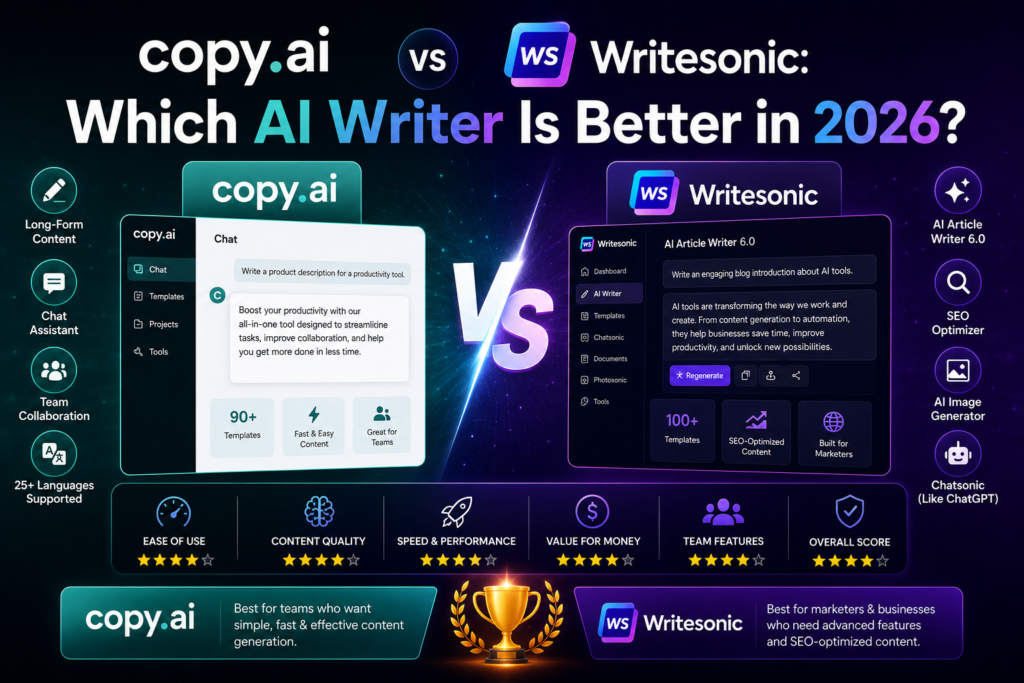
Copy.ai vs Writesonic: Comparison Table
| Feature | Copy.ai | Writesonic |
| Primary focus | Sales/GTM copy & workflows | SEO articles & content marketing |
| Free plan | Yes — 2,000 words/mo | Yes — limited trial credits |
| Starting price | $36/mo (Starter) | $16/mo (Lite) |
| Long-form article writer | Basic | Excellent (research + citations) |
| SEO features | Minimal | Built-in checks + Surfer-style optimization |
| Workflow automation | Excellent (multi-step workflows) | Limited |
| Templates | 90+ short-form focused | 100+ incl. article frameworks |
| Chatbot included | Chat by Copy.ai | Chatsonic (with web search) |
| Brand voice | Yes | Yes |
| Best for | Sales teams, founders, agencies doing outreach | Bloggers, SEO agencies, niche site owners |
| Our rating | 4.2/5 | 4.2/5 |
Round 1: Long-Form Content and SEO Articles
This round is not close. Writesonic’s AI Article Writer is a genuine pipeline: give it a keyword, and it researches live web sources, drafts a structured article with citations, inserts tables and FAQs, and scores the result against on-page SEO factors (keyword placement, headings, length, links). Our test article on a mid-competition keyword came out at 2,100 words with accurate, sourced statistics and needed roughly 40 minutes of human editing to publishable standard.
Copy.ai can write blog posts through its chat and workflow tools, but there is no comparable research-cite-optimize pipeline. Its drafts read fine yet arrive unsourced and unoptimized — you become the research department. For anyone producing search content weekly, that difference compounds fast.
Winner: Writesonic, decisively.
Round 2: Short-Form Copy and Sales Outreach
Reverse the picture for short copy. Copy.ai’s workflow engine is its superpower: chain steps like scrape prospect’s LinkedIn → summarize their company news → draft personalized cold email → generate two follow-ups, then run that workflow across a 200-row prospect list. Our cold campaign test produced personalized first-touch emails that referenced each prospect’s actual context — work that would take an SDR days — in under an hour of setup.
Writesonic handles individual short-form pieces well (ads, product descriptions, social posts) but has nothing like Copy.ai’s batch personalization. Its strength is one good asset at a time, not a thousand tailored variants.
Winner: Copy.ai, decisively.
Round 3: Output Quality Head-to-Head
On identical prompts with each tool’s default settings, our blind-scored results split by format. Blog introductions: Writesonic won 7/10 (better hooks, cleaner structure). Product descriptions: tie (both formulaic without brand-voice setup, both solid with it). Cold emails: Copy.ai won 8/10 (more natural personalization, less template smell). Social captions: Copy.ai 6/10, slightly punchier. Neither tool matches Claude or ChatGPT for raw prose elegance — both are workflow tools wrapped around capable-but-unspectacular generation, which is why editing remains mandatory on both.
Winner: Tie — quality follows each tool’s specialty.
Round 4: Pricing and Real Cost
| Plan | Copy.ai | Writesonic |
| Free | 2,000 words/mo, 1 seat | Trial credits |
| Entry | Starter $36/mo — unlimited words, 1 seat | Lite $16/mo (annual) — generous credits |
| Mid | Advanced $186/mo — 5 seats, workflows | Standard ~$79/mo — full SEO suite, more articles |
| Scale | Custom GTM plans | Professional/Advanced tiers |
Writesonic wins the entry point: $16/month buys real article production, and even its credit-based model comfortably covers a typical blogger’s monthly output. Copy.ai’s $36 Starter includes unlimited words — great value for heavy short-form users — but its workflow features, the actual reason to choose it, largely live in the $186+ tiers aimed at sales teams with budgets. Factor hidden costs too: Writesonic’s higher article quotas sit in higher tiers, and Copy.ai workflows consume credits at scale.
Winner: Writesonic for individuals; Copy.ai only makes financial sense when workflows replace SDR hours.
Round 5: Ease of Use and Learning Curve
Writesonic is the gentler start: pick Article Writer, enter a keyword, follow the wizard. New users shipped their first full article in our onboarding test within 20 minutes. Copy.ai’s chat and templates are equally simple, but its real value — multi-step workflows — demands an afternoon of learning and some process thinking; non-technical users in our test needed the template gallery to get started. Both offer brand voice setup that takes minutes and pays off immediately.
Winner: Writesonic for time-to-value; Copy.ai’s ceiling rewards the climb.
Use-Case Verdicts
- Niche site or blog owner: Writesonic — the article pipeline is built for you.
- SEO agency producing client content: Writesonic, paired with human editors.
- Sales team or founder doing outbound: Copy.ai, no contest.
- E-commerce store (descriptions at scale): Copy.ai’s workflows batch better; Writesonic acceptable for smaller catalogs.
- Social media manager: Slight edge Copy.ai for caption variety and repurposing workflows.
- All-purpose solo creator on a budget: Writesonic at $16 — or honestly, ChatGPT at $20 if you do not need SEO tooling (see our ChatGPT vs Claude comparison).
What Both Tools Get Wrong
A fair copy.ai vs writesonic review should name the shared weaknesses. First, editing is not optional: both produce drafts that read competent and slightly hollow until a human adds experience, opinion, and verification — publishing raw output is how sites get buried by helpful-content updates. Second, fact-checking remains on you: Writesonic’s citations reduce but do not eliminate errors, and Copy.ai offers no sourcing at all. Third, both upsell aggressively: expect feature gates and plan-nudges throughout the interface. Budget your real cost at the tier that actually contains the features you came for.
A Note on AI Models Under the Hood
Both platforms now route requests across multiple frontier models rather than a single provider, selecting by task — which means raw generation quality between them converges over time and will keep converging. That is exactly why this comparison weights workflow, integrations, and specialty features so heavily: the model layer is becoming a commodity both companies rent, while the product layer around it is where your subscription money actually buys differentiation. Evaluate accordingly, and expect the gap on any given output type to narrow between our test dates and yours.
How We Tested
Both platforms ran for three weeks on matched workloads: five SEO articles on identical keywords, 30 product descriptions, a 50-prospect cold email campaign, and a two-week social calendar. Two editors blind-scored 120 outputs for quality and edit-time-to-publishable; we logged setup time for each major feature and verified all pricing in May 2026 on current published plans.
Round 6: Brand Voice, Integrations, and Team Features
Both platforms now ship brand-voice training, and both work: paste samples, get a reusable profile. Writesonic’s voice held up well across articles but applies less consistently in its chat product, while Copy.ai’s voice plugs directly into workflows — meaning a 200-email batch all sounds like your SDR team, which is the higher-stakes use of the feature. On integrations, the platforms again mirror their identities: Writesonic connects outward to publishing and SEO (WordPress export, Surfer-style optimization, web research baked in), while Copy.ai connects to revenue infrastructure (CRMs, sales engagement tools, enrichment data sources, plus Zapier/Make for everything else). Team features are serviceable on both, with Copy.ai’s higher tiers offering the more developed seat management — unsurprising given its enterprise sales focus.
Winner: tie, split by ecosystem — content stack vs. revenue stack.
Two Real Workflows, Start to Finish
Abstract comparisons hide what daily use feels like, so here is one concrete workflow per tool from our test month.
Writesonic: a ranking-targeted article in 70 minutes. We targeted a commercial keyword in the productivity niche. Article Writer ingested the keyword, asked clarifying questions about angle and audience, then researched live sources and produced a 2,100-word draft with citations, a comparison table, and an FAQ in about six minutes. The built-in SEO score flagged thin keyword coverage in two H2s and a missing internal link. Human time went to: verifying the eleven cited statistics (two were outdated — replaced), rewriting the intro hook, injecting our own testing anecdote, and tightening conclusions. Total human editing: ~55 minutes to a piece we would publish on this site. The pipeline’s value was never the prose — it was compressing research, structure, and optimization into one pass.
Copy.ai: a 50-prospect outbound campaign in 90 minutes. We uploaded a CSV of 50 SaaS prospects with names, companies, and LinkedIn URLs. The workflow we assembled: enrich each company with a one-line summary → identify a recent trigger (funding, launch, hiring) → draft a first-touch email referencing that trigger in our trained brand voice → generate two follow-ups at different angles. Setup took the bulk of the time; execution across all 50 rows took minutes. Spot-checking 15 outputs: 11 were send-ready after light edits, 3 needed their personalization fixed (the AI overreached on thin data), 1 was discarded. A human SDR doing equivalent research-and-draft work budgets 10–15 minutes per prospect — call it ten hours compressed into ninety minutes, which is the entire argument for Copy.ai’s pricing.
The asymmetry is the lesson: Writesonic saves you an afternoon per piece; Copy.ai saves you a week per campaign.
Switching Costs and Migration Notes
Moving onto either platform is light: both import brand samples in minutes and neither holds your content hostage (everything exports as text or docx). Moving between them is where teams get surprised. Writesonic refugees miss its research citations immediately — budget for manual sourcing or a separate research step in Copy.ai. Copy.ai refugees lose their workflows entirely; nothing in Writesonic replicates multi-step automation, so plan to rebuild that layer in Zapier or Make (our Zapier vs Make comparison covers which). If genuinely torn, the cheap experiment is running both free tiers against one real week of your actual workload — the winner is usually obvious by Wednesday.
The Verdict by Team Size and Budget
Because the right answer shifts with scale, here is the decision compressed by situation. Solo creator under $20/month: Writesonic Lite — the only plan on either platform that delivers its tool’s core value at entry price. Solo founder doing their own outbound: Copy.ai free for drafting plus manual personalization; the paid workflows are not priced for one person. Content team of 2–5: Writesonic Standard, with one human editor owning the verification pass — the article pipeline scales linearly with seats. Sales team of 3+: Copy.ai’s workflow tiers, where the SDR-hours math finally works; pilot on one campaign before committing annually. Agency serving both content and outbound clients: genuinely consider running both, billed into client retainers — they overlap so little that the combined stack has no redundancy. And in every scenario, keep a frontier chatbot subscription alongside: neither platform matches Claude or ChatGPT for the unstructured thinking work (strategy memos, angle brainstorms, awkward client emails) that surrounds the production these tools industrialize.
Frequently Asked Questions
Writesonic is better for blogs, SEO articles, and content marketing; Copy.ai is better for sales outreach, personalization at scale, and GTM workflows. Pick by your primary output — content chooses Writesonic, outreach chooses Copy.ai.
Yes — Copy.ai’s free plan includes 2,000 words per month and one seat, enough to evaluate the writing quality but not the workflow automation that defines the paid product.
Yes, it is the stronger SEO tool of the two: its Article Writer performs live research with citations and includes built-in on-page optimization scoring. Rankings still depend on editing quality and site authority, not the generator alone.
No. Both replace the blank page and the first draft, cutting production time dramatically, but outputs need human editing for accuracy, voice, and originality. Teams that treat them as junior drafters get great results; teams that treat them as publish-buttons get generic content.
Copy.ai — 2,000 words monthly with no expiration beats Writesonic’s one-time trial credits. For more genuinely free options, see our best free AI writing tools roundup.
If you need neither Writesonic’s SEO pipeline nor Copy.ai’s workflow automation, yes — ChatGPT or Claude at $20/month writes as well or better. These tools earn their keep through workflow, not prose.
Final Verdict
The copy.ai vs writesonic question answers itself once you name your job. Writesonic (4.2/5) is the better content machine — research, drafting, and SEO optimization in one $16 pipeline that bloggers and agencies can build a publishing schedule on. Copy.ai (4.2/5) is the better revenue machine — its workflows turn prospect lists into personalized outreach in ways no rival on this page matches, at prices that assume sales-team budgets. Content marketers go left, sales teams go right, and both should keep a human editor between the AI and the publish button.
One last decision shortcut if you have read this far and remain torn: open your last month of work and count outputs. If most of what you shipped was meant to be found (articles, guides, pages targeting search), Writesonic. If most was meant to be sent (emails, messages, sequences targeting inboxes), Copy.ai. The tools have specialized so cleanly that your own output log is the most reliable reviewer you will find. *Disclaimer: AIGearTools tests every product hands-on; results reflect our usage in May 2026 and may differ from yours. Some links are affiliate links — we may earn a commission at no extra cost to you, which never affects verdicts. Pricing and features change frequently; confirm on official websites.